
How Much Does a Business Website Cost in India (2026)?
A transparent breakdown of what goes into website pricing — design, development, hosting, and maintenance — so you know what to budget for and what to avoid overpaying for.
In This Article
Every business is going online, but one of the first questions owners ask is simple: how much does a business website cost in India in 2026? The honest answer is that there is no single price. A small brochure website, a lead-generation website, an e-commerce store, and a custom business platform can have completely different budgets. The right approach is to understand what you are paying for, what affects the price, and which features actually matter for your business.
Key Points
What you need to know
Number of pages
More pages require more design, content, development and testing.
Custom design
Custom layouts usually require more strategy and production time than templates.
Business functionality
Bookings, payments, dashboards, integrations and automation increase complexity.
Content quality
Copywriting, photography, illustrations and product content can affect the total budget.
SEO and performance
Technical foundations, image optimisation and testing should be planned from the start.
Ongoing support
Maintenance, updates, monitoring and future improvements create continuing costs.
Why business website prices vary
Website pricing changes because projects have different goals and levels of complexity. A basic website may need a handful of pages, a contact form and responsive design. A more advanced project may need custom UI, payment gateways, booking systems, dashboards, integrations, animations, content management and ongoing optimisation. The number of pages is only one part of the calculation.
Typical website cost ranges in India
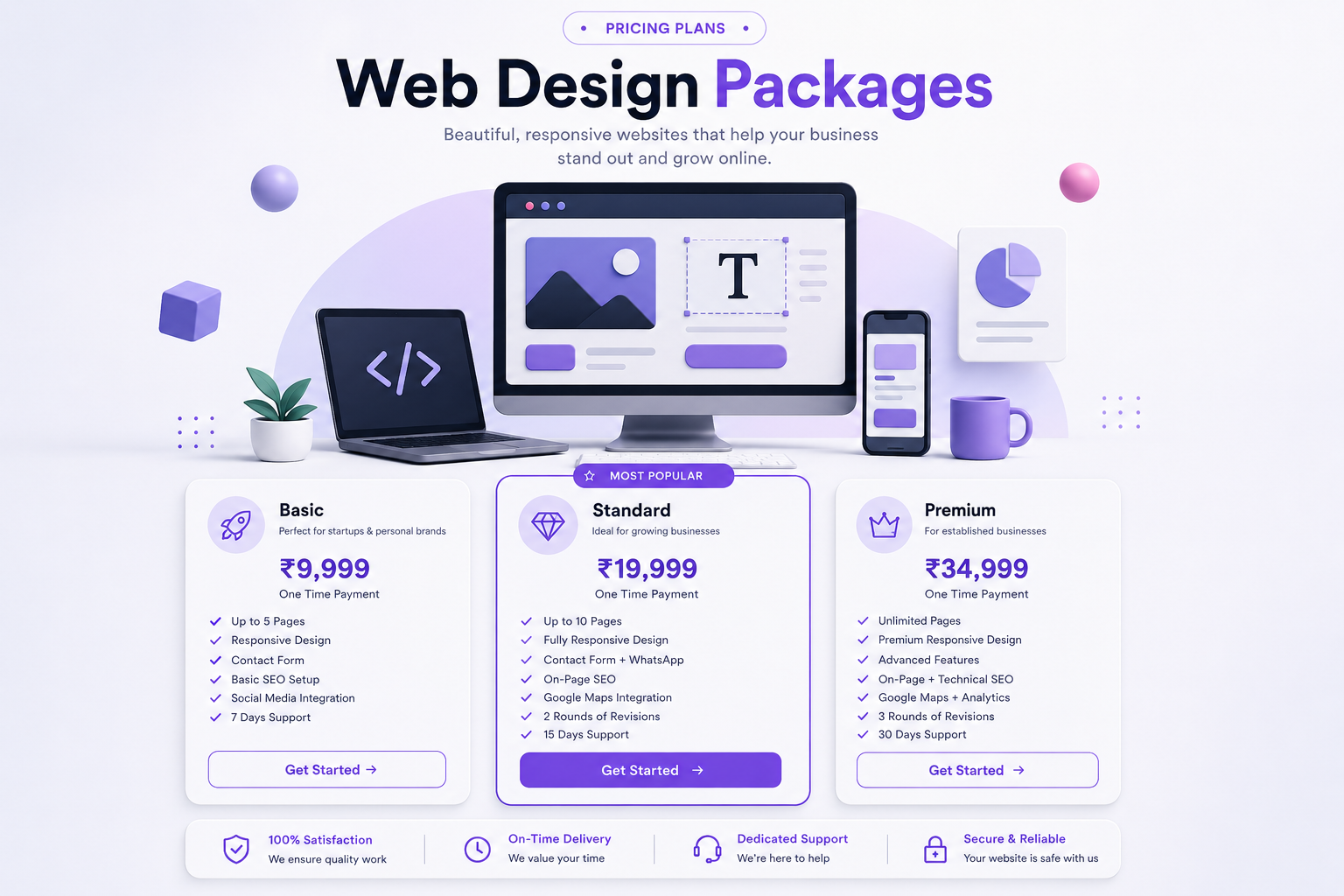
For a small business, the budget can range from a relatively simple starter website to a fully custom digital experience. Template-based projects are generally cheaper because much of the visual structure already exists. Custom-designed websites cost more because every important screen, component and interaction is planned around the brand and customer journey. E-commerce and custom web applications can cost considerably more because they involve transactions, data, security and additional testing.
Design and user experience affect the budget
Professional web design is not just about making a page look attractive. A good design creates hierarchy, makes information easy to scan, builds trust and guides visitors toward an action. Custom typography, responsive layouts, brand-specific components, illustrations, interaction design and mobile optimisation all require additional work. If your website is expected to generate enquiries, design quality can be a business investment rather than a cosmetic expense.
Development and functionality
The development stage turns the design into a working website. Costs increase when the project requires features such as advanced forms, appointment booking, customer dashboards, payment processing, product catalogues, search, filters, third-party APIs or automation. A reliable build should also consider accessibility, performance, validation, error handling and mobile behaviour.
Hosting, domain, SSL and maintenance
The website build is not the only expense. Businesses also need a domain, hosting and a secure HTTPS setup. Over time, there may be costs for backups, security updates, content changes, monitoring, bug fixes and feature improvements. Planning for maintenance prevents a website from becoming outdated shortly after launch.
How to avoid overpaying
Do not compare proposals only by the number at the bottom. Compare what is included: number of pages, custom design, copywriting, responsive development, SEO foundations, forms, integrations, analytics, revisions, deployment and support. A very low quote can become expensive if important work is excluded or charged later.
What should be included in a professional business website
At minimum, a strong business website should communicate the offer clearly, work well on mobile devices, load efficiently, provide obvious contact options, use trustworthy content, include basic technical SEO and have analytics configured. Depending on the business, it may also need WhatsApp, booking, CRM or payment integrations.
How to choose the right budget
Start with the business outcome instead of starting with a feature list. If the goal is to generate local enquiries, prioritise clear service pages, strong calls to action, local SEO foundations and fast performance. If the goal is online sales, prioritise product pages, checkout, payments, shipping and analytics. If the goal is credibility, invest in brand presentation, case studies and content.
Final thoughts on website investment
A website should be treated as part of a wider digital system rather than a one-time decoration. The best budget is the one that gives your business the functionality, credibility and performance it actually needs without paying for unnecessary complexity. Define the goal, list the essential features, compare complete scopes and keep an allowance for maintenance and future improvements.
Questions to ask before accepting a website quote
Ask exactly what the quoted price includes and what happens if the project changes. Clarify the number of design concepts, revision rounds, pages, forms, integrations, content support and deployment work. Ask whether the website will be editable after launch and who will own the domain, hosting account, source code and design assets. It is also useful to understand the expected timeline and what the client must provide before development can begin. A transparent proposal should explain assumptions instead of hiding important costs in vague language. You should also ask how performance, responsive behaviour, basic accessibility and technical SEO will be handled. If ongoing support is offered, ask what counts as maintenance and what counts as a new feature. These questions make proposals easier to compare and reduce the risk of selecting a low initial price that becomes much higher during development.
A practical way to plan your website budget
Start by separating must-have requirements from nice-to-have features. Your must-have list might include core service pages, a contact form, mobile responsiveness, analytics, basic SEO, WhatsApp or another contact channel, and a clear conversion path. Nice-to-have items could include advanced animations, complex dashboards, custom calculators or unusual integrations. Build the first version around the customer journey and add advanced features when there is a clear business reason. It is also sensible to reserve a portion of the budget for content, photography, revisions, launch testing and post-launch improvements. Once the website is live, watch which pages attract visitors and which actions produce enquiries. Those observations can guide future investment more effectively than adding features simply because competitors have them.
What to prioritise in the first version
A first version should focus on the pages and actions that support the business goal. For most service businesses, that means a strong homepage, focused service pages, an about or credibility section, contact options and useful proof such as testimonials or case studies. Make the site easy to update and leave room for future additions. Avoid spending a large portion of the budget on effects that do not improve understanding or conversion. Once the website has real visitor data, you can invest more confidently in the pages and features customers actually use. This approach keeps the initial project practical while creating a foundation for future SEO, content marketing, advertising and automation. It also makes conversations with a developer easier because the scope is based on business priorities rather than a long list of disconnected features.
Yorra Tech
Ready to turn your digital presence into a growth tool?
Tell us about your business, your goals, and what you want your website or digital system to achieve.
Start a Project